

What Whole-Person Care Looks Like Inside a High-Performing CHA
Part 2 in a series on whole-person care and well-executed CHAs
Most patients have options when it comes to health assessments. They can visit a primary care physician, complete a telehealth or telephonic screening, or receive an in-home health visit. A well-executed Comprehensive Health Assessment (CHA) is the most complete option of them all. A CHA is not simply an assessment of a patient’s current health status. It is a fully connected, 45- to 60-minute clinical encounter designed to see the member as a whole person, surface what other settings routinely miss, and ensure that what is found in the home leads somewhere meaningful.
That distinction matters because identification alone does not change outcomes. What changes outcomes is the chain of action that follows: a skilled clinician assessing health status in its real-world context, conducting in-home screenings that close care gaps on the spot, and ensuring every finding connects to a clear, coordinated next step on behalf of the member. This is what whole-person care looks like in practice.
In part 1 of this series, we explained whole-person care as the organizing principle behind a high-performing home-based care model. In this post, we unpack the three make-or-break actions that a high-performing CHA must deliver during the in-home visit to produce measurably better patient and population-level results:
- Put the ‘on paper’ situation into full context.
- Reduce patient friction — and close care gaps — in real time.
- Ensure every finding leads to a coordinated next step.
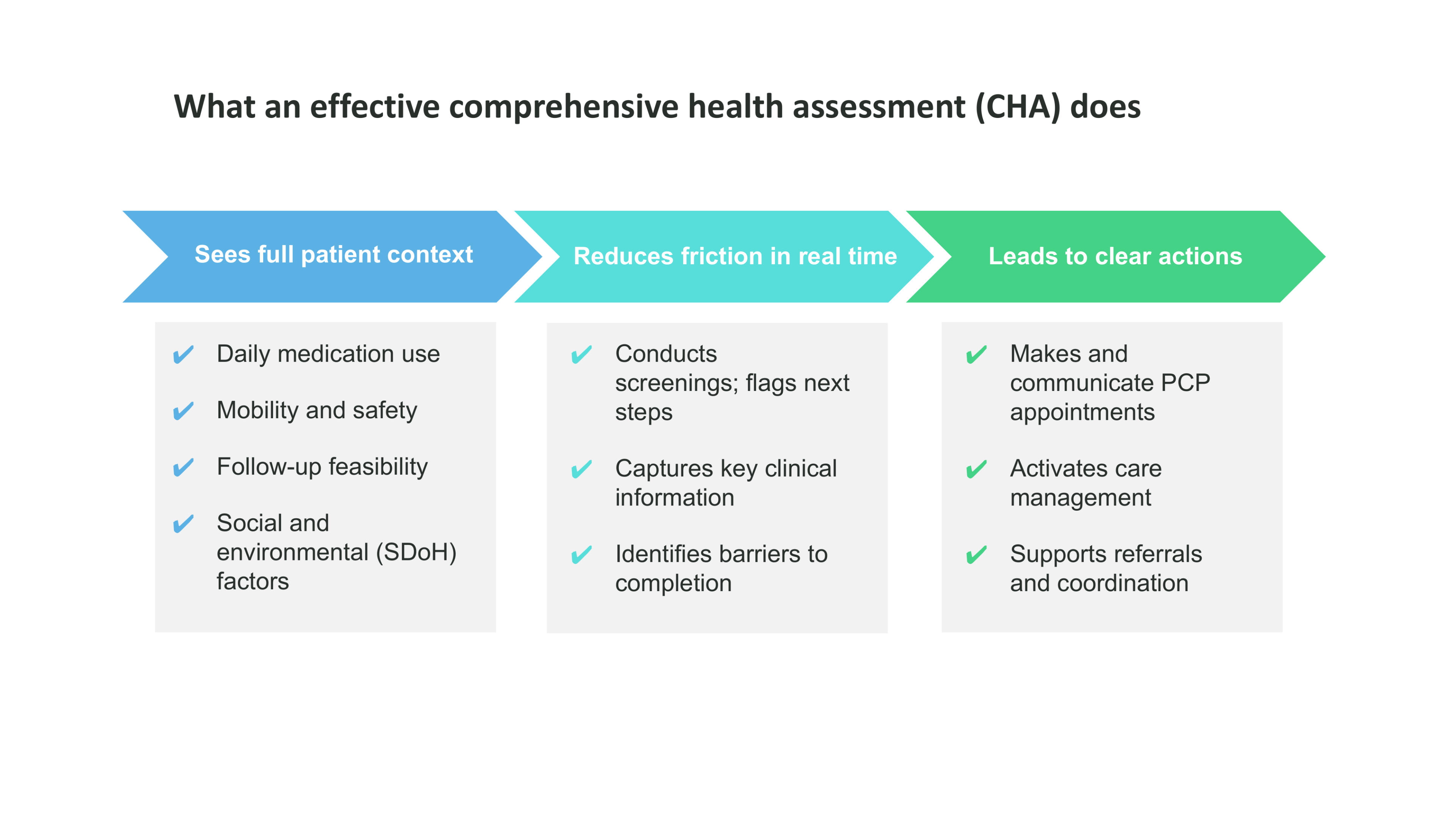
Let’s take a closer look at how each of these must play out for the CHA to deliver on its full potential.
1. Put the ‘on-paper’ situation into full context: Seeing what the chart alone cannot
Most care gap strategies rely on what the chart shows. A high-performing CHA starts by testing whether that version of the patient’s situation is true — and then goes several critical steps further.
The chart may show a medication list, a diagnosis, and a history of care utilization. But it can’t show whether the member is taking those medications correctly, whether mobility concerns are making follow-up appointments difficult, or whether financial pressures have quietly disrupted an otherwise reasonable care plan. Before identifying a gap in care, the clinician must consider some fundamental questions: Is good care functionally possible at home? Are medications being taken as prescribed? Does the member understand what comes next? Is the next step realistically reachable?
In addition to capturing the clinical picture that normally lives in a medical chart, our Nurse Practitioners are gathering context that only the home environment can reveal: daily medication use and adherence, mobility and safety observations, social and environmental (SDoH) factors, and the practical barriers that make even well-designed care plans difficult to execute. This grounding in lived reality is what makes the encounter meaningful — and it’s what enables the next two steps to happen at all.
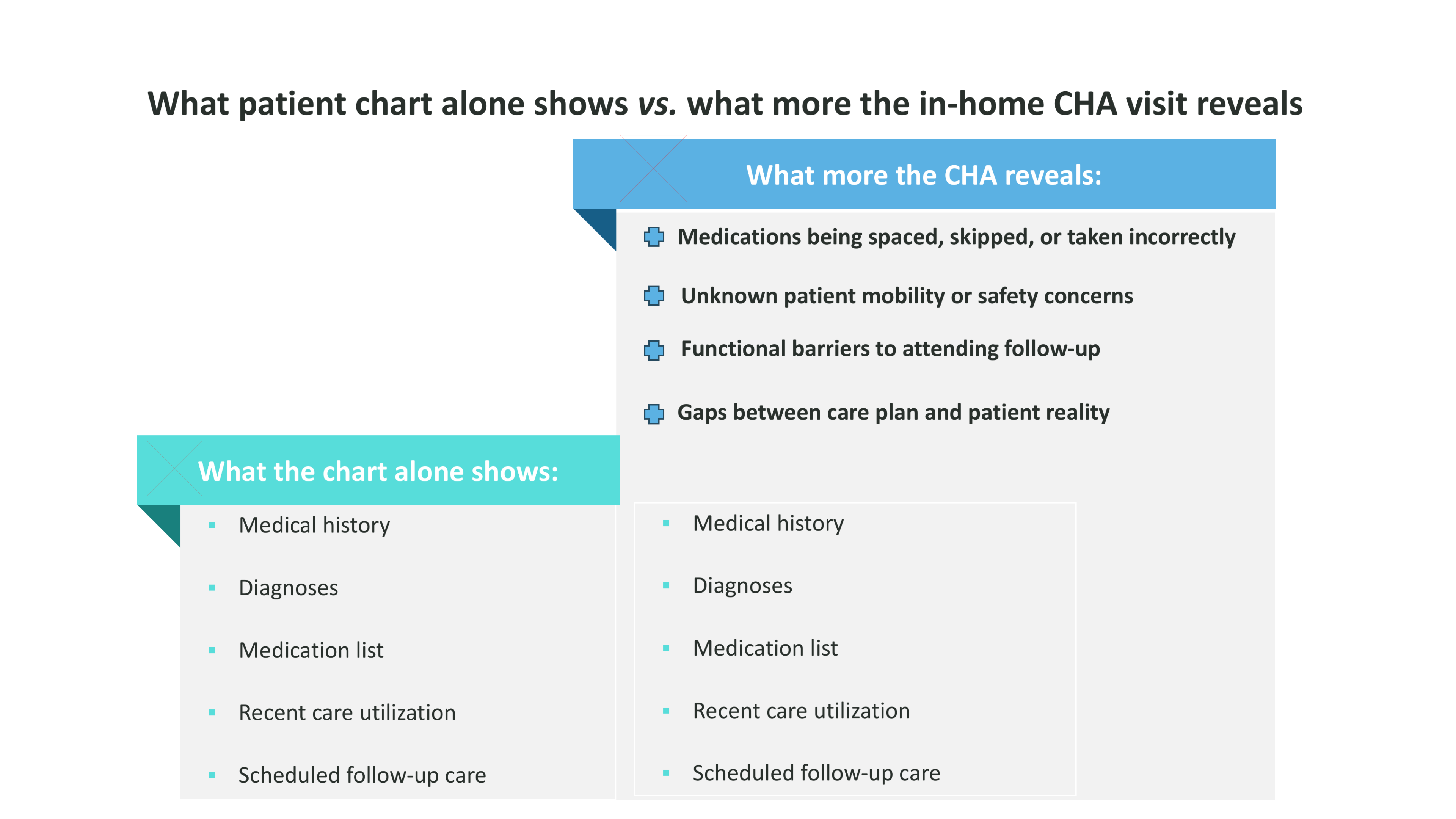
That means the insights from the full patient context don’t just inform the record. They directly enable what comes next: conducting in-home screenings and closing care gaps in real time, and ensuring every member is connected to coordinated follow-up care. The in-home context is the foundation on which both are built.
Example: A Nurse Practitioner visits a member with diabetes and hypertension whose claims history suggests limited recent utilization. During the visit, vitals are captured and medications reviewed — and the NP learns the member has been spacing doses to save money. The issue is not just nonadherence. It is affordability, confusion, and a care plan that is no longer working in the member’s daily life. That finding immediately shapes which in-home screenings are prioritized and what follow-up appointments are scheduled on the member’s behalf.
2. Reduce patient friction — and close care gaps — in real time: Problem-solving during the encounter
A well-designed CHA does not stop at identifying overdue care. It is built to move that care closer to completion — and in many cases, to complete it — while the opportunity is still in front of the clinician.
This is where the Matrix approach becomes uniquely powerful. Our Nurse Practitioners don’t just conduct the CHA — they are equipped and trained to perform in-home clinical screenings during the same encounter. That means blood pressure checks, HbA1c fingerstick testing, retinal imaging, urine and blood sample collection for kidney health evaluation, and FIT kit distribution for colorectal cancer screening can all happen in the member’s home, in a single visit. No separate scheduling. No additional appointments. No follow-through required from a member who may already be struggling to navigate the system.
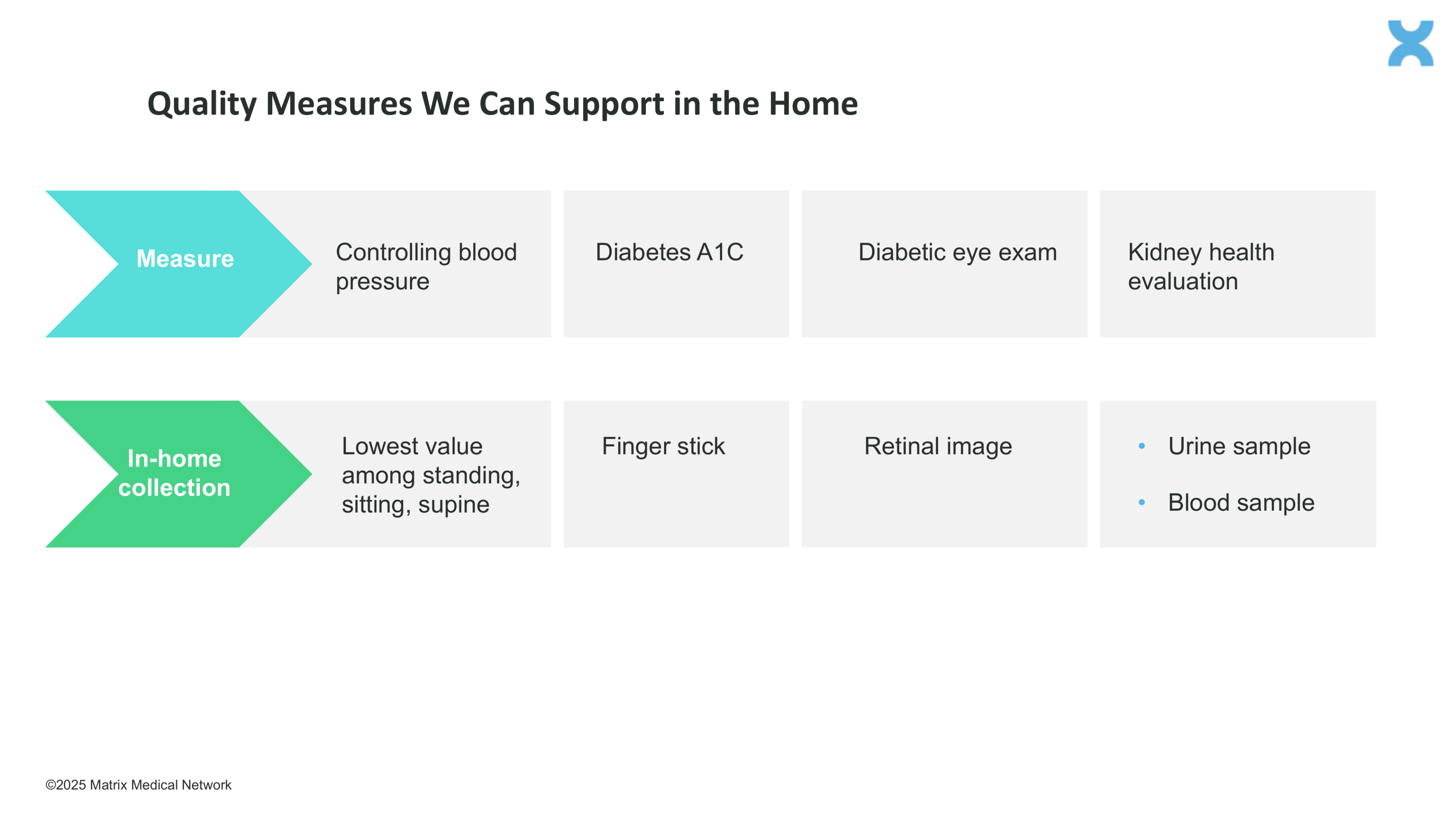
The visit itself creates a unique clinical moment. By the time the Nurse Practitioner is ready to conduct screenings, she has already built genuine rapport with the member. The member understands why each screening matters, what the results mean, and what will happen next. That rapport — built through the CHA itself — is not incidental. It is the reason members are more willing to participate in screenings they may have previously declined or deferred.
This single-encounter model is how Matrix delivers maximum value to both the member and our health plan clients in one visit. Care gaps that would otherwise require multiple touchpoints, referrals, and months of follow-through are closed on the spot. The member receives care that is convenient, personalized, and actionable. The health plan receives documented results, CPTII codes, and measurable quality measure closure — all from a single clinical encounter.
This is especially true for fall risk and medication-related risk, where early warning signs often show up in the home before they become serious events. And it’s true for the broader range of MA quality measures — because the in-home CHA is not a reminder that something is overdue. It is the mechanism that gets it done.
3. Ensure every finding leads to a coordinated next step: From insight to action
Identification without follow-through is where most in-home programs lose their value. It’s not enough to surface a need, document a finding, or hand the member a list of recommended next steps. The question is: who makes sure those next steps happen?
Matrix answers that question at scale. We deliver tens of thousands of Care Management Referrals (CMRs) to our health plan clients every year, ensuring that members with identified needs are connected to the clinical and community-based resources most likely to help them. We coordinate directly with PCPs and other members of the care team — communicating findings, flagging urgent concerns, and ensuring clinical continuity. For many in-home programs, that is where care coordination ends.
At Matrix, we have built something more orchestrated. Because identifying a need and referring a member is still not enough if the appointment never gets made, we have developed a proactive, end-to-end appointment scheduling capability — initiated on behalf of the member before the Nurse Practitioner even leaves the home.
That process starts with the follow-up PCP appointment — the single most important connection point in restoring care continuity — and extends into a broader set of services based on each member’s individual findings:
- Specialist appointments, including cardiology, nephrology, and behavioral health
- Preventive screenings such as mammograms, colonoscopies, and eye exams
- Community-based organization (CBO) services to address social determinants of health, including transportation, food access, and housing support
- Pharmacy and medication support programs for members experiencing adherence barriers
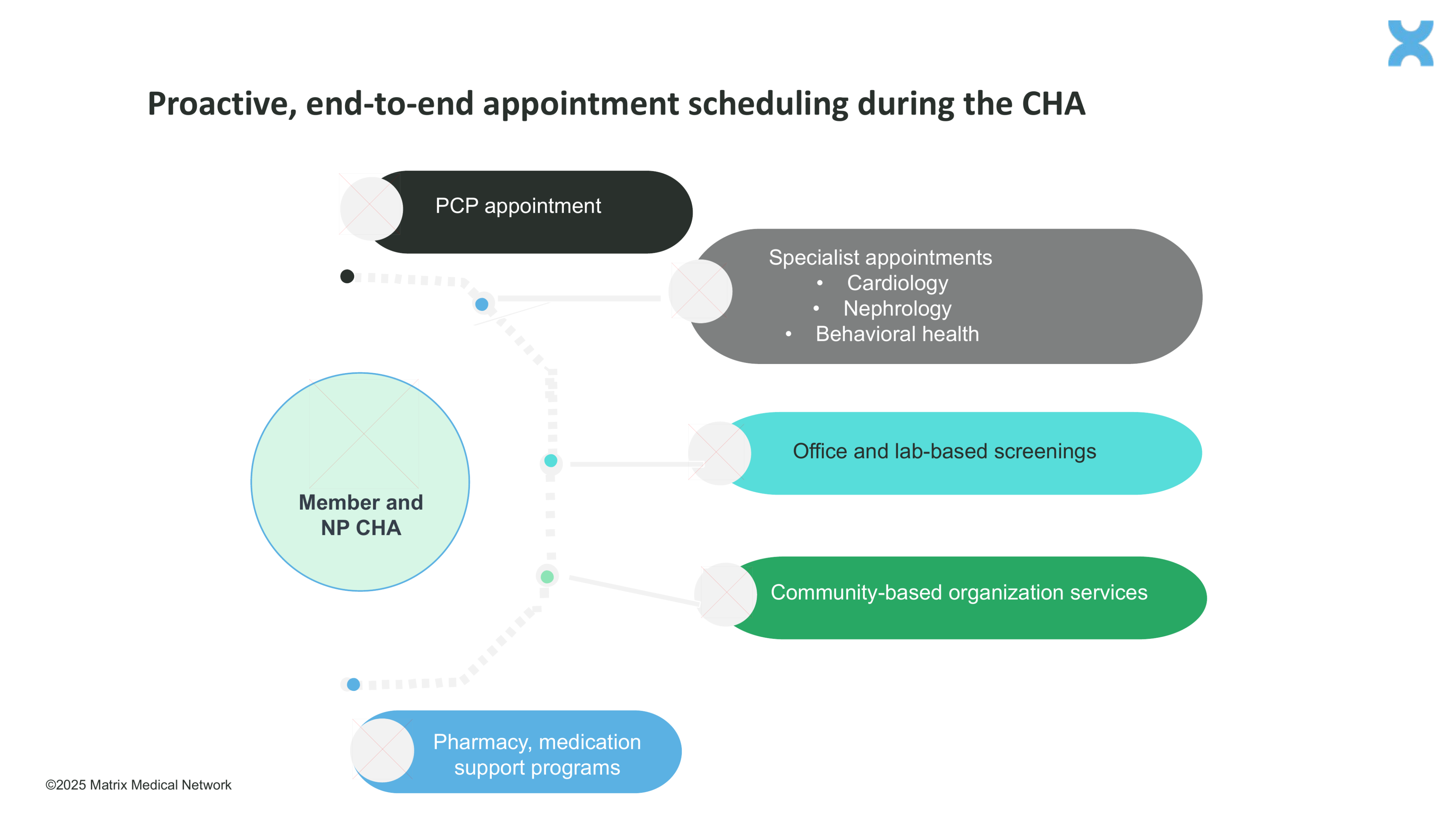
This is the difference between a program that produces reports and one that produces results. When Matrix schedules the appointment, the member does not have to navigate a system they may find confusing or discouraging. The friction is removed. The care happens.
From actions to impact: What a well-executed CHA delivers
A results-oriented CHA is distinguished not by what takes place during the visit, but by the full chain of value it sets in motion. At Matrix, that chain has three links: a deeply contextualized clinical assessment that sees what the chart cannot; a single-encounter model that conducts in-home screenings and closes care gaps while the clinician is still in the room; and a coordinated care activation engine that schedules follow-up — from the PCP to the specialist to the community resource — on behalf of the member.
Together, these three capabilities add up to something that goes far beyond documentation. They represent a comprehensive, connected model of care that meets members where they are, addresses what is actually getting in the way of their health, and ensures that what is found in the home does not stay in the home.
The member who was spacing insulin doses to afford groceries gets a revised care plan, a medication cost support referral, and a PCP appointment scheduled before the NP leaves. The member whose mammogram has been overdue for three years has it scheduled — not recommended, scheduled. The member showing early signs of depression is connected to behavioral health services the same day their symptoms are identified.
This is the standard Matrix brings to every CHA. Not just a visit. Not just a record. A comprehensive, sometimes life-changing encounter that gives health plans confidence that their members are not just being seen — they are being cared for.
About Matrix Medical Network
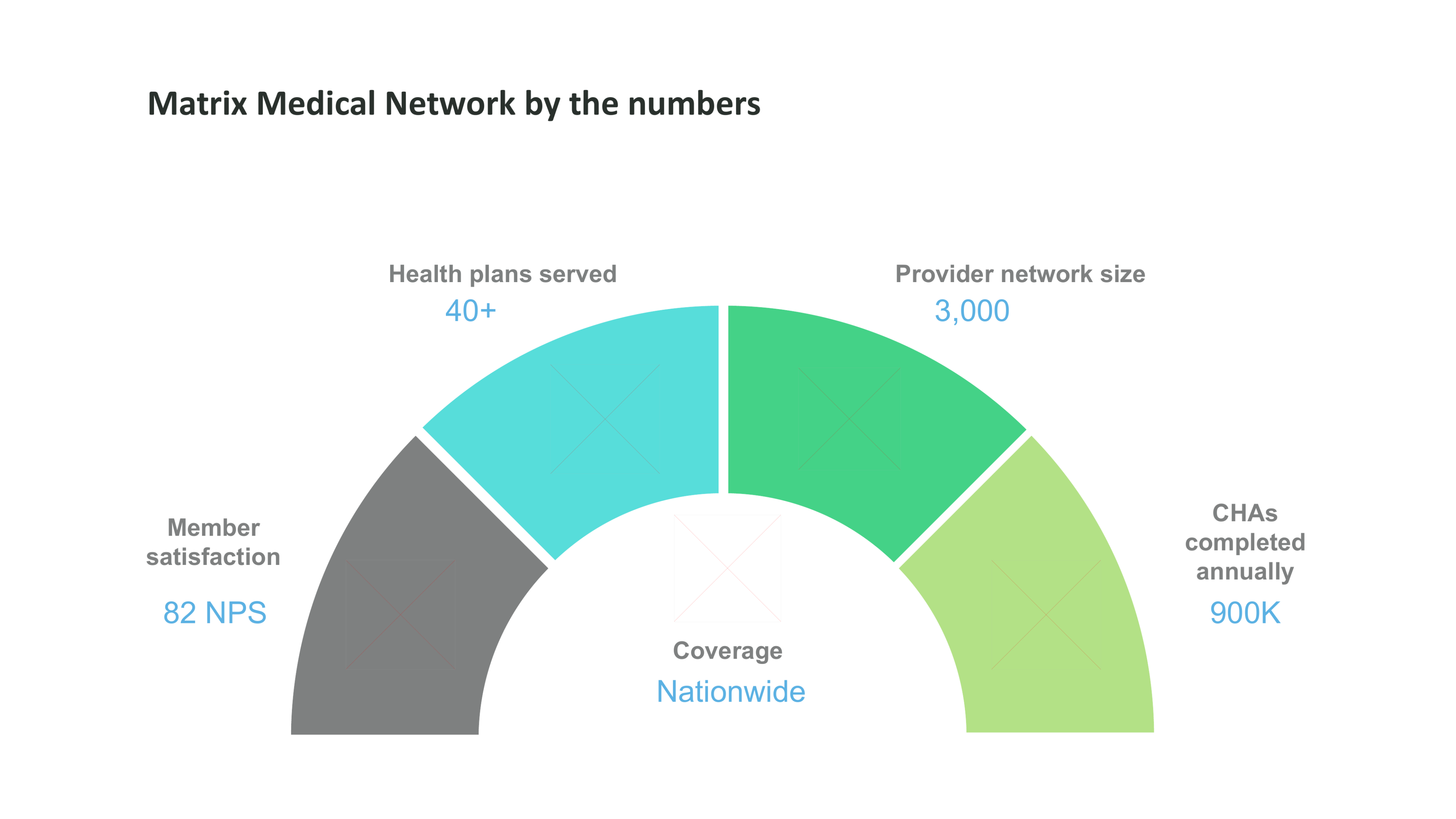
Matrix Medical Network was established over 25 years ago and today, we are an independent, at-scale provider of home-based health and care services across the nation. We uncover meaningful insights, close critical gaps in care and activate healthier outcomes through our in-home clinical encounters. For more information, please contact us.


Related Posts
Closing the Loop: How Matrix CHAs meet CMS’s 2027 Continuity-of-Care Standard
When a Matrix comprehensive health assessment (CHA) identifies a member need, 45% of those members see their PCP within 60 days and 77% within 90 days1. That kind of follow-through has always mattered—and, it’s about to matter a lot more. Beginning in 2027, CMS will exclude “unlinked” chart…
HCC Coding 101: What Health Plans Need to Know About Diagnosis Coding Accuracy
Managing health plan operations requires balancing care quality, financial stability and regulatory compliance. At the center of this balance is diagnostic documentation integrity. When diagnosis coding reflects a member’s full health profile, your organization can accurately forecast care needs, allocate clinical resources and maintain compliance. However, when documentation falls…
What Is a Comprehensive Health Assessment (CHA) and Why It Matters for Risk-Bearing Organizations
For health plans, ACOs and other risk-bearing organizations, understanding member health accurately is the foundation of both quality care and sound operational management. Administrative claims data and brief office visits can miss critical clinical, behavioral and environmental details, creating blind spots that can lead to unexpected hospitalizations and unaddressed…