

Closing the Loop: How Matrix CHAs meet CMS’s 2027 Continuity-of-Care Standard

When a Matrix comprehensive health assessment (CHA) identifies a member need, 45% of those members see their PCP within 60 days and 77% within 90 days1. That kind of follow-through has always mattered—and, it’s about to matter a lot more.
Beginning in 2027, CMS will exclude “unlinked” chart review diagnoses from Medicare Advantage risk adjustment. In other words, conditions will only count toward risk adjustment if they can be connected to a clinical service. This new policy doesn’t just tighten documentation rules. It draws a hard line between plans that can prove a member’s need led to real care, versus plans that can only prove that a member need was observed and written down. Putting plans on the right side of the line is where CHAs earn their value.
Most Care Models Aren’t Built For Follow-through
Because MA risk adjustment has long rewarded plans for finding conditions at scale, even when there was no record of what happened next, most existing care models are built only to spot needs, not to prove follow-through. Outreach lists, referrals and gap flags are common outputs. But once a need is logged, many programs have limited visibility into whether that member issue was ever resolved. Was the member scheduled? Seen? Was the encounter connected back to the original diagnosis in a way that would satisfy a reviewer?
For most plans, honest answers include “it depends,” and “it’s hard to prove either way.” It’s a longstanding operational gap—one that now has a financial and audit consequence, thanks to CMS’s policy update.
How Matrix CHAs Close the Loop
In contrast, Matrix CHAs are structured to ensure observed member needs connect to documentable actions. There are two keys to this:
- The visit itself is the clinical encounter. Every diagnosis captured during an in-home CHA is already tied to a documented clinical service — the assessment itself — giving it a natural, defensible link that unlinked chart reviews can’t offer.
- After-visit steps are reported. When a CHA surfaces a need, Matrix tracks the next step whether it’s a PCP follow-up, care management engagement, or condition-specific support. That reporting gives its partners the same thing CMS is now requiring: visible, trackable proof that an identified need turned into delivered care.
Stakes for Adapting To The New Reality Vary By Plan Type
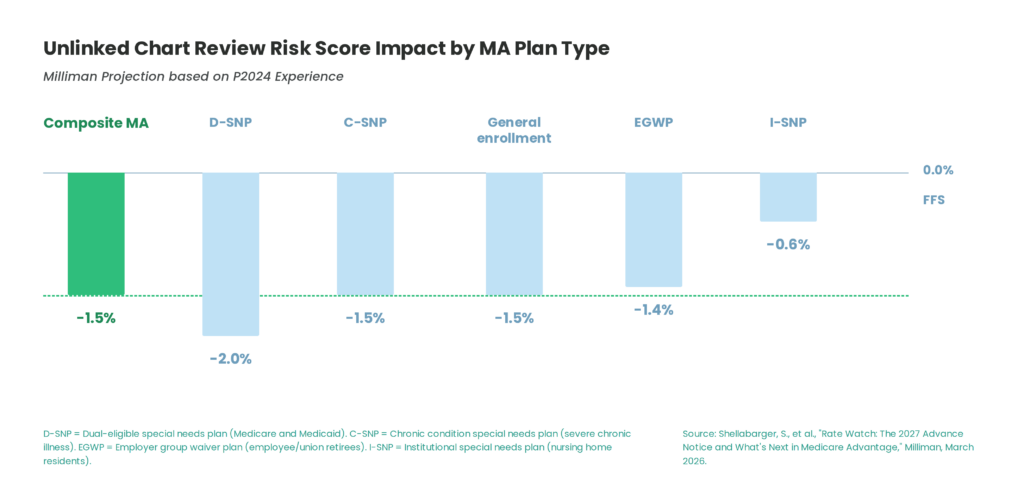
How much is at stake for fast care model adaptation differs by organization. The more a given plan has relied on chart-review-only diagnosis capture, the steeper the projected risk-adjustment factor (RAF impact from the 2027 change. Reliance on unlinked chart reviews differs by insurer type, and also by population served (as shown in the chart below).
In either case, the best way for plans to address gaps is to shift volume toward encounter-based programs, such as CHAs, before the policy takes effect.
How Plans Can Activate CHA Findings
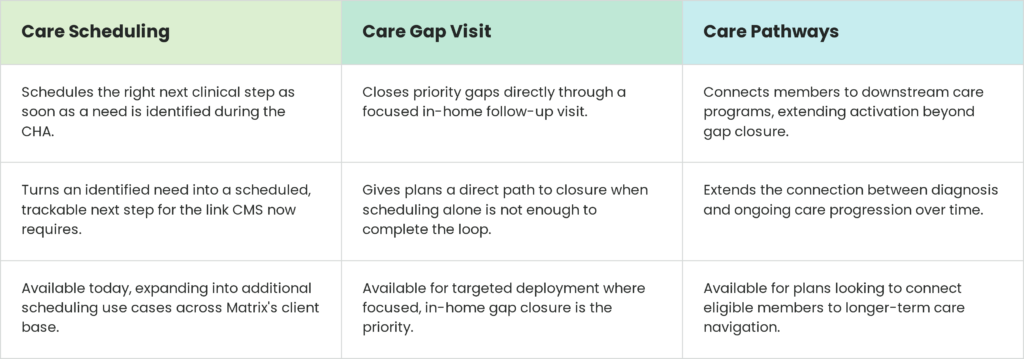
Matrix supports the full range of follow-through, from a single scheduled visit to an ongoing care pathway:
What This Means for 2027 Planning
In addition to being a clinical best practice, continuity of care is becoming a core input to how Medicare Advantage plans support risk adjustment, quality performance and revenue integrity. CMS’s 2027 exclusion gives that shift a clear deadline.
Care models that stop at diagnostic identification will keep losing ground under this standard. The ones that hold up will be the ones that can show, visibly and consistently, that an identified need became delivered care.
That is where Matrix CHAs stand out. Not just because they capture member information, but because they’re structured to prove that identified needs lead to delivered care in a way that meets the higher scrutiny standard.
2027 program design decisions are happening now. If your team is evaluating how to shift risk-adjustment activity toward encounter-based, auditable models, talk to your Matrix account team about sizing a CHA program, including Care Scheduling, Care Gap Visit or Care Pathways, to your plan’s specific unlinked-chart exposure.
About Matrix Medical Network
Matrix Medical Network was established over 25 years ago and today, we are an independent, at-scale provider of home-based health and care services across the nation. We uncover meaningful insights, close critical gaps in care, and activate healthier outcomes through our in-home clinical encounters.
For more information, please contact us.
1 CHA population based on all CHAs performed in 2023. Office visits computed using calendar 2023 and early 2024 claims data to identify visits with an outpatient E&M CPT code. Includes members enrolled 180 days after the CHA or after non-CHA baseline date.


Related Posts
HCC Coding 101: What Health Plans Need to Know About Diagnosis Coding Accuracy
Managing health plan operations requires balancing care quality, financial stability and regulatory compliance. At the center of this balance is diagnostic documentation integrity. When diagnosis coding reflects a member’s full health profile, your organization can accurately forecast care needs, allocate clinical resources and maintain compliance. However, when documentation falls…
What Is a Comprehensive Health Assessment (CHA) and Why It Matters for Risk-Bearing Organizations
For health plans, ACOs and other risk-bearing organizations, understanding member health accurately is the foundation of both quality care and sound operational management. Administrative claims data and brief office visits can miss critical clinical, behavioral and environmental details, creating blind spots that can lead to unexpected hospitalizations and unaddressed…
Quantifying Connection: Why Social Connectedness Is Becoming a Critical Health Indicator for Risk-Bearing Organizations
For older adults, a shrinking social network is far more than an emotional challenge; it’s a hidden health risk that directly drives up acute care utilization and total cost of care. For risk-bearing organizations, failing to identify and measure social isolation creates significant blind spots in risk adjustment, quality…